Start a Home Care Agency in New Hampshire
Starting a non-medical home care agency in New Hampshire requires understanding the state’s licensing requirements, service definitions, and administrative expectations before providing care.
New Hampshire is considered a regulated state, meaning agencies that provide personal care services must obtain approval before operating.
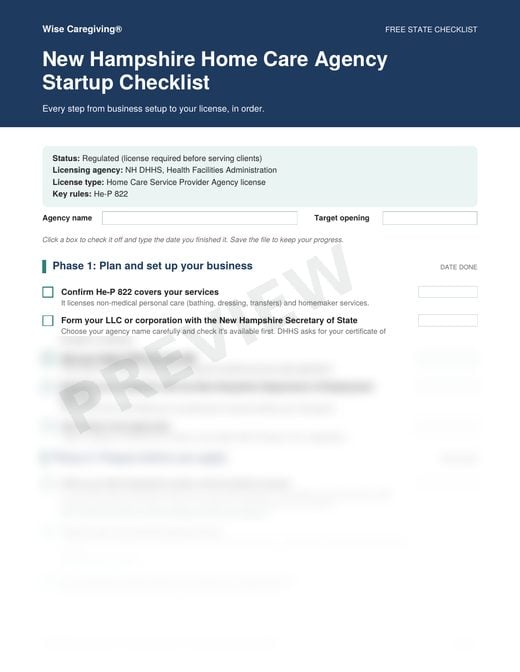 Preview of page 1 of 3
In New Hampshire, non-medical home care agencies are typically licensed as Home Care Service Provider Agencies (HCSPA) under He-P 822.
This guide outlines the key steps, expectations, and important considerations so you can better understand what is involved in opening a home care agency in New Hampshire.
Which bundle do you need? New Hampshire is a regulated state.
Understand New Hampshire Home Care Licensing Requirements
In New Hampshire, agencies providing non-medical home care services must obtain licensure as a Home Care Service Provider Agency (HCSPA) under He-P 822.
These agencies are regulated by the:
New Hampshire Department of Health and Human Services (DHHS)
Health Facilities Administration (HFA)
If your agency provides:
• personal care (bathing, dressing, grooming)
• assistance with activities of daily living (ADLs)
• supervision and support
you are required to obtain a license before operating.
What Makes New Hampshire Different
New Hampshire stands out for its structured but accessible licensing process.
Key characteristics include:
• clearly defined provider category
• emphasis on administrative organization
• requirement for policies and procedures
• potential inspection or review prior to approval
Compared to larger states, New Hampshire is more manageable but still requires preparation.
Define Your Services
Most home care agencies in New Hampshire provide:
• personal care assistance
• companionship services
• meal preparation
• light housekeeping
• mobility support
Providing hands-on care places your agency under full regulatory oversight.
Complete Business Setup Requirements
Before applying, you must:
• register your business (LLC or Corporation)
• obtain a Federal EIN
• secure general liability insurance
• obtain workers’ compensation insurance (if hiring employees)
• establish a business location
• designate an administrator
New Hampshire expects agencies to be properly structured before applying.
Prepare Your Administrative Documentation
A critical part of the licensing process is preparing your agency’s documentation.
This includes:
• policies and procedures
• caregiver hiring and training records
• client intake and service forms
• operational documentation
Documentation must be organized, consistent, and aligned with your operations.
Submit Your Application
Once your documentation is prepared, you will:
• submit your Home Care Service Provider application
• provide required documentation
• pay applicable licensing fees
Incomplete applications are a common cause of delays.
Prepare for Survey or Inspection
New Hampshire may require a survey or inspection process before approval.
During this stage, your agency will be evaluated for:
• administrative organization
• documentation consistency
• caregiver training
• client care documentation
• compliance readiness
Receive Approval and Begin Operations
You may begin providing services only after:
• your license has been issued
• your agency meets all regulatory requirements
Medicaid Pathway in New Hampshire
New Hampshire offers opportunities for agencies to participate in Medicaid programs.
This typically requires:
• additional provider enrollment
• compliance with program requirements
• adherence to service documentation standards
New Hampshire Home Care Startup Checklist
✔ Register your business entity
✔ Obtain EIN and insurance
✔ Define your services
✔ Prepare administrative documentation
✔ Submit application
✔ Prepare for inspection (if required)
✔ Receive approval and begin services
Current Market Opportunity in New Hampshire
New Hampshire presents strong opportunities due to:
• an aging population
• increasing demand for in-home care
• limited provider availability in certain areas
Opportunities often exist in:
• suburban communities
• smaller towns
• underserved regions
Application Review Timeline
Approval timelines vary depending on application completeness and review requirements.
In general:
• applications may take approximately 2 to 4 months
• additional steps may extend timelines
Level of Difficulty: Moderate (Structured and Manageable)
New Hampshire is considered a moderate difficulty state.
It requires:
• structured documentation
• organized preparation
• readiness for review
Helpful Government Resources
New Hampshire Department of Health and Human Services
https://www.dhhs.nh.gov
What New Agency Owners Often Miss
Common challenges include:
• incomplete documentation
• lack of preparation for review
• inconsistent policies and forms
• unclear workflows
New Hampshire-Specific Insight: Smaller State, Strong Standards
While New Hampshire is smaller than many states, it maintains strong regulatory expectations.
Agencies must demonstrate:
• organization
• consistency
• readiness to operate
Building a Cohesive Home Care System
Many agency owners create documentation over time, which can lead to:
• inconsistent formatting
• disconnected policies and forms
• unclear workflows
A well-prepared agency should have documentation that is consistent, structured, and aligned with real-world operations.
A More Structured Approach for New Hampshire
For regulated states like New Hampshire, many agency owners choose a structured starting point.
Wise Caregiving® offers a regulated state startup bundle that includes:
• a customized policy and procedure manual
• a structured framework aligned with regulatory expectations
• fully editable forms designed to support your policies
• a cohesive documentation system
This allows you to focus on preparing your business and moving forward with confidence.
Prepare with Confidence
Starting a home care agency in New Hampshire requires preparation and organization.
Beginning with a structured system can help you move forward with clarity and confidence.
Explore the Regulated State Startup Bundle →
Stay Updated
State requirements may change over time. This page is reviewed regularly.
Last Updated: October 2026
LIVE UPDATELatest New Hampshire licensing updates
October 2026: No new changes to New Hampshire’s home care licensing requirements this month.
We check New Hampshire’s official state sources at the start of every month. Last checked: October 2026.
New Hampshire is a regulated state
The bundle you need: Regulated State Start-Up Bundle, with a policy and procedure manual written for New Hampshire and your agency, plus the full library of 250+ templates.
Get the Regulated State Bundle for New Hampshire
Only need part of it? You can buy the custom New Hampshire manual on its own, the forms bundle without a manual or individual forms separately. Questions? Message us in the shop chat.