Start a Home Care Agency in Nebraska
Starting a non-medical home care agency in Nebraska requires understanding the state’s requirements, service definitions, and administrative expectations before providing care.
Nebraska is considered a non-regulated state for private-pay home care: the state does not license private-pay non-medical agencies, even when your employees provide hands-on personal care.
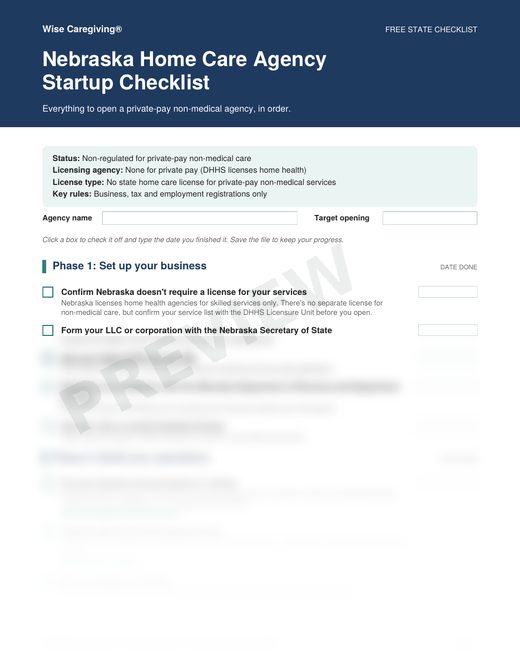 Preview of page 1 of 3
Nebraska does not license private-pay non-medical home care agencies, but state law (Neb. Rev. Stat. §§71-6501 to 71-6504) sets rules for these “in-home personal services agencies”: workers must be at least 18, pass criminal history and registry checks, and be trained for the services they provide. Agencies offering skilled nursing need a Home Health Agency license from DHHS.
This guide outlines the key steps, expectations, and important considerations so you can better understand what is involved in opening a home care agency in Nebraska.
Which bundle do you need? Nebraska is a non-regulated state.
Understand Nebraska Home Care Requirements
Nebraska is a non-regulated state for private-pay, non-medical home care. No state license is required, even when your own employees provide hands-on personal care such as bathing, dressing, grooming and toileting.
Nebraska does not license private-pay non-medical home care agencies, but state law (Neb. Rev. Stat. §§71-6501 to 71-6504) sets rules for these “in-home personal services agencies”: workers must be at least 18, pass criminal history and registry checks, and be trained for the services they provide. Agencies offering skilled nursing need a Home Health Agency license from DHHS.
Even without a license, Nebraska law requires you to run criminal history and registry checks on every worker, check driving records when driving is part of the job, and keep those records on file at your place of business.
You still need to set up your business properly, carry the right insurance, screen your caregivers and keep professional records.
What Makes Nebraska Different
Nebraska does not license private-pay non-medical agencies, which lowers the barrier to entry. Oversight comes mainly through Medicaid program rules (if you choose to serve Medicaid clients), state worker-screening requirements, and general business, employment and insurance requirements.
Define Your Services
Most home care agencies in Nebraska provide:
• personal care assistance
• companionship services
• meal preparation
• light housekeeping
• mobility support
Providing hands-on care places your agency under full regulatory oversight.
Complete Business Setup Requirements
Before applying, you must:
• register your business (LLC or Corporation)
• obtain a Federal EIN
• secure general liability insurance
• obtain workers’ compensation insurance (if hiring employees)
• establish a business location
• designate an administrator
Nebraska expects agencies to be properly structured prior to application.
Prepare Your Administrative Documentation
A critical part of getting started is preparing your agency’s documentation.
This includes:
• policies and procedures
• caregiver hiring and training records
• client intake and service forms
• operational documentation
Documentation must be organized, consistent, and aligned with your operations.
Set Up for Private-Pay Services
There is no state license application for private-pay non-medical care in Nebraska. Before serving clients, make sure you have:
- a registered business entity and EIN
- general liability, professional liability and workers’ compensation insurance
- criminal background checks for every caregiver
- written policies, procedures and client agreements
- the state worker-screening records described above
If you plan to serve Medicaid clients, you will also need to enroll through the state Medicaid program.
Plan for Oversight (Medicaid Only)
Private-pay agencies are not surveyed by the state. If you enroll in Medicaid, expect program reviews, audits and documentation checks.
Begin Operations
You can begin serving private-pay clients once your business is set up, insured and your caregivers are screened. No state approval is needed for private-pay non-medical care.
Medicaid Pathway in Nebraska
Nebraska offers opportunities for agencies to participate in Medicaid programs.
This typically requires:
• additional provider enrollment
• compliance with program requirements
• adherence to service documentation standards
Nebraska Home Care Startup Checklist
- Register your business entity
- Obtain an EIN and insurance
- Define your services
- Screen your caregivers (state-required checks)
- Prepare policies and documentation
- Decide whether to enroll in Medicaid (optional)
- Begin private-pay services
Current Market Opportunity in Nebraska
Nebraska presents strong opportunities due to:
• an aging population
• demand for in-home care services
• need for services in both urban and rural areas
Opportunities often exist in:
• suburban communities
• smaller cities
• underserved rural regions
Startup Timeline
Because there is no state license for private-pay non-medical care, many Nebraska agencies can open within a few weeks of forming the business. Medicaid enrollment, if you pursue it, can take several months.
Level of Difficulty: Low to Moderate
Nebraska has no state license for private-pay non-medical care, so the main work is business setup, insurance, caregiver screening and strong documentation. Serving Medicaid clients adds program requirements.
Helpful Government Resources
Nebraska Department of Health and Human Services
https://dhhs.ne.gov
What New Agency Owners Often Miss
Common challenges include:
• incomplete documentation
• confusion between private-pay and Medicaid rules
• inconsistent policies and forms
• unclear workflows
Nebraska-Specific Insight: No License, but Documentation Still Matters
Without a state license, clients, families and referral sources judge your agency by how professional it is. Clear policies, consistent forms and well-trained caregivers set you apart.
Building a Cohesive Home Care System
Many agency owners create documentation over time, which can lead to:
• inconsistent formatting
• disconnected policies and forms
• unclear workflows
A well-prepared agency should have documentation that is consistent, structured, and aligned with real-world operations.
A More Structured Approach for Nebraska
For non-regulated states like Nebraska, many agency owners choose a structured starting point.
Wise Caregiving® offers a non-regulated state startup bundle that includes:
• an all-state policy and procedure manual you customize yourself
• a structured framework for professional operations
• fully editable forms designed to support your policies
• a cohesive documentation system
This allows you to focus on preparing your business and moving forward with confidence.
Prepare with Confidence
Starting a home care agency in Nebraska requires preparation and organization.
Beginning with a structured system can help you move forward with clarity and confidence.
Explore the Non-Regulated State Startup Bundle →
Stay Updated
State requirements may change over time. This page is reviewed regularly.
Last Updated: October 2026
LIVE UPDATELatest Nebraska licensing updates
October 2026: No new changes to Nebraska’s home care licensing requirements this month.
Earlier in 2026: Guide correction: Nebraska does not license private-pay non-medical agencies, but state law requires worker background checks, registry checks and training.
We check Nebraska’s official state sources at the start of every month. Last checked: October 2026.
Nebraska is a non-regulated state
No state home care license is required for private-pay non-medical care. The bundle you need: Non-Regulated State Start-Up Bundle, with an all-state policy and procedure manual you edit yourself, plus 250+ templates in total.
Get the Non-Regulated State Bundle
Only need part of it? You can buy the all-state policy manual on its own, the forms bundle without a manual or individual forms separately. Questions? Message us in the shop chat.