Start a Home Care Agency in Massachusetts
Starting a non-medical home care agency in Massachusetts requires understanding the state’s regulatory structure, service expectations, and administrative requirements before providing care.
Massachusetts is considered a regulated state, but it operates differently than many others. Rather than a traditional licensing model for all agencies, the level of oversight can depend on the services offered and whether the agency participates in state-funded programs.
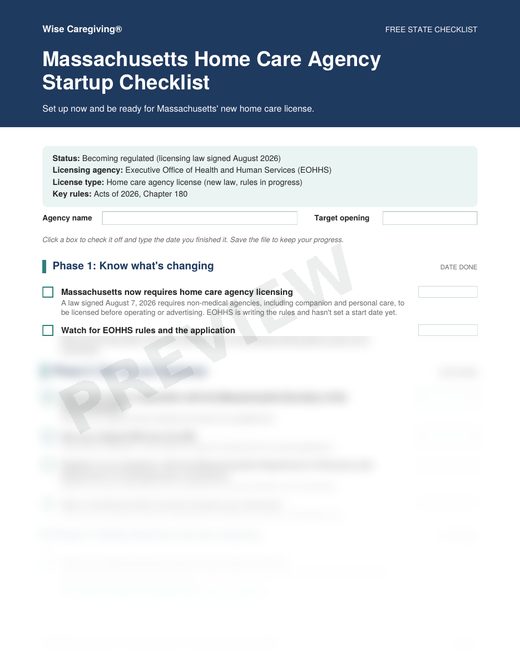 Preview of page 1 of 3
This guide outlines the key steps, expectations, and important differences so you can better understand what is involved in opening a home care agency in Massachusetts.
Which bundle do you need? Massachusetts is a regulated state.
1️⃣ Understand Massachusetts Home Care Requirements
In Massachusetts, non-medical home care agencies are commonly referred to as:
Home Care Providers or Home Care Agencies
Oversight may involve:
Massachusetts Executive Office of Health and Human Services (EOHHS)
MassHealth (for Medicaid participation)
Massachusetts is moving to full licensing. A new law (Chapter 180 of the Acts of 2026) takes effect November 4, 2026 and requires home care agencies, including private-pay companion and personal care agencies, to be licensed by the Executive Office of Health and Human Services (EOHHS). The state will first issue temporary licenses, then adopt regulations within a year; every agency must be licensed no later than one year after those rules are adopted. Licenses will last 3 years. Fees have not been announced yet. Until then, agencies must still:
• operate as a registered business
• follow applicable labor and employment laws
• maintain proper documentation and internal policies
• meet standards if participating in state-funded programs
2️⃣ What Makes Massachusetts Different
Massachusetts stands out because it is not structured like a typical license-first state.
Key differences include:
• some non-medical home care agencies may operate without a traditional state license
• regulation increases if you participate in MassHealth (Medicaid)
• strong emphasis on business compliance, staffing, and documentation
This can create confusion for new agency owners, as requirements depend on how the agency plans to operate.
3️⃣ Define Your Services
Most home care agencies in Massachusetts provide:
• personal care assistance
• companionship services
• meal preparation
• light housekeeping
• mobility support
If your agency provides hands-on personal care, you must ensure your operations meet applicable standards, especially if working with state-funded programs.
4️⃣ Complete Business Setup Requirements
Before operating, you must:
• register your business (LLC or Corporation)
• obtain a Federal EIN
• secure general liability insurance
• obtain workers’ compensation insurance (if hiring employees)
• establish a business address
• designate an administrator or owner
Even without formal licensing, Massachusetts expects agencies to operate professionally and in compliance with business laws.
5️⃣ Prepare Your Administrative Documentation
Regardless of licensing requirements, all home care agencies must prepare administrative documentation.
This typically includes:
• policy and procedure documentation
• client intake and service forms
• caregiver hiring and training records
• operational and compliance documentation
Documentation should be organized, consistent, and reflective of how your agency will operate in practice.
6️⃣ Consider Medicaid (MassHealth) Participation
If you plan to participate in MassHealth, additional requirements apply.
This may include:
• provider enrollment
• compliance with service-specific standards
• additional documentation and oversight
This pathway involves a more structured approval process compared to private-pay agencies.
7️⃣ Prepare for Oversight or Review (If Applicable)
Depending on your services and programs, your agency may be subject to:
• audits
• program reviews
• compliance checks
Agencies participating in state-funded programs should be prepared for higher levels of oversight.
8️⃣ Begin Operations
Once your business is properly established and documentation is in place, you may begin providing services.
Agencies participating in MassHealth must complete the required enrollment and approval steps before serving clients under those programs.
Massachusetts Home Care Startup Checklist
✔ Register your business entity
✔ Obtain EIN and insurance
✔ Define your services
✔ Prepare administrative documentation
✔ Determine if you will participate in MassHealth
✔ Complete provider enrollment (if applicable)
✔ Begin operations
Current Market Opportunity in Massachusetts
Massachusetts has a strong and growing demand for home care services due to:
• an aging population
• high preference for aging in place
• increasing need for personal care support
Opportunities often exist in:
• suburban communities
• densely populated regions
• areas with limited access to reliable home care providers
Even in competitive markets, demand for consistent and professional care remains high.
Application / Startup Timeline in Massachusetts
Because Massachusetts does not always require a traditional license, startup timelines can vary:
• private-pay agencies may begin operations relatively quickly
• agencies pursuing MassHealth enrollment may take several months
• additional documentation or approvals may extend timelines
Preparation and clarity in your business model will impact how quickly you can begin.
Level of Difficulty: Low to Moderate (Depends on Pathway)
Massachusetts is considered:
👉 Lower difficulty for private-pay agencies
👉 Moderate difficulty for Medicaid participation
The complexity depends on:
• whether you pursue MassHealth
• how structured your agency is at startup
Helpful Government Resources
For official information:
👉 Massachusetts Executive Office of Health and Human Services
https://www.mass.gov/orgs/executive-office-of-health-and-human-services
👉 MassHealth Provider Information
https://www.mass.gov/masshealth
What New Agency Owners Often Miss in Massachusetts
Many new agency owners:
• assume no structure is required because licensing may not be mandatory
• overlook the importance of documentation
• underestimate requirements for MassHealth participation
• fail to build a cohesive system from the start
Even without a traditional license, organization and structure are still essential.
Massachusetts-Specific Insight: Flexible Entry, Structured Growth
Massachusetts differs from many states by allowing more flexible entry for private-pay agencies, while still requiring structure and compliance.
Agencies that plan ahead and build organized systems are better positioned to:
• grow
• expand services
• participate in state-funded programs
Building a Cohesive Home Care System
Many agency owners create documentation over time, leading to:
• inconsistent formatting
• disconnected policies and forms
• unclear workflows
A well-prepared agency should have documentation that is:
• consistent
• clearly structured
• aligned with real-world operations
A More Structured Approach for Massachusetts
Even in states with more flexible entry, many agency owners choose to start with a structured foundation.
Wise Caregiving® offers home care startup template bundles that include:
• a professionally structured policy and procedure manual
• editable forms designed to support operations
• a cohesive system for documentation and compliance
This allows you to:
• organize your business from the start
• create consistency across your documents
• prepare for future growth and compliance
Prepare with Confidence
Starting a home care agency in Massachusetts requires clarity, organization, and planning.
Beginning with a structured system can help you build a strong foundation and grow with confidence.
Explore Home Care Startup Template Bundles →
Stay Updated
State requirements and timelines may change over time. This page is reviewed and updated regularly to reflect current information.
Last Updated: October 2026
LIVE UPDATELatest Massachusetts licensing updates
October 2026: No new changes to Massachusetts’s home care licensing requirements this month.
Earlier in 2026: Massachusetts has passed its first home care agency licensing law (Chapter 180 of the Acts of 2026). It takes effect November 4, 2026; EOHHS will issue temporary licenses first and publish full rules and fees within about a year.
We check Massachusetts’s official state sources at the start of every month. Last checked: October 2026.
Massachusetts is a regulated state
The bundle you need: Regulated State Start-Up Bundle, with a policy and procedure manual written for Massachusetts and your agency, plus the full library of 250+ templates.
Get the Regulated State Bundle for Massachusetts
Only need part of it? You can buy the custom Massachusetts manual on its own, the forms bundle without a manual or individual forms separately. Questions? Message us in the shop chat.