Want to start a home care agency in Colorado? If you plan to offer non-medical personal care, such as help with bathing, dressing, meals, light housekeeping and companionship, you need a Class B Home Care Agency license from the Colorado Department of Public Health and Environment (CDPHE) before you serve your first client.
This guide walks you through each step in plain language, from forming your business to submitting your application in COHFI, CDPHE’s online licensing portal.
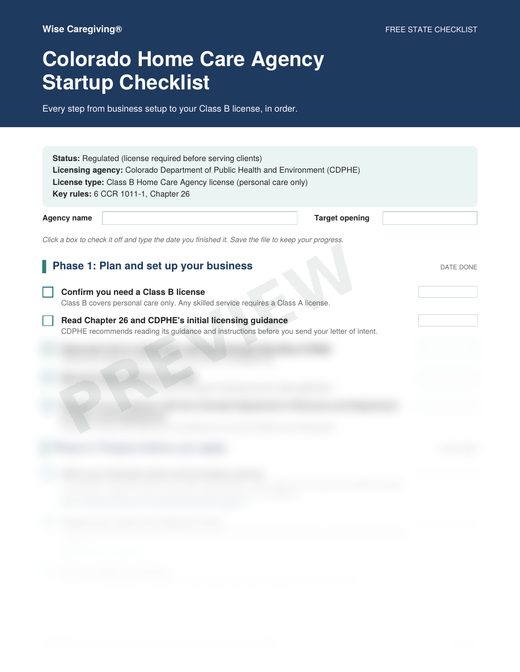 Preview of page 1 of 3
Which bundle do you need? Colorado is a regulated state.
Get the Regulated State Bundle for Colorado1. Understand Colorado’s Home Care Licensing Requirements
In Colorado, home care agencies are licensed by the Colorado Department of Public Health and Environment (CDPHE). There are two license classes:
- Class A license: for agencies that provide skilled health care by licensed professionals, such as nurses, certified nurse aides and therapists. Class A agencies may also provide personal care.
- Class B license: for agencies that provide personal care services only, with no skilled health care.
Most non-medical home care agencies need a Class B license. The rules are in 6 CCR 1011-1, Chapter 26 (Home Care Agencies), along with the general licensing standards in Chapter 2.

2. Choose a Business Structure
Pick a legal structure, such as a limited liability company (LLC) or a corporation, to protect your personal assets. Check that your agency name is available, then file your formation documents with the Colorado Secretary of State.
3. Get Your Tax IDs
- Federal EIN: apply free online with the IRS. You need it for payroll, banking and your license application.
- Colorado wage withholding account: register with the Colorado Department of Revenue.
- Unemployment insurance account: register with the Colorado Department of Labor and Employment (CDLE) before you hire.
4. Write Your Policies and Procedures
Chapter 26 expects your agency to run on written policies and procedures, covering things like client rights, services, staffing, supervision, complaints and record keeping. CDPHE will review how you operate, so have these ready before you apply.
To save weeks of writing, start from a Colorado-customized home care policy and procedure manual and pair it with ready-to-use home care forms.
5. Plan Hiring, Background Checks and Training
Set up your hiring process before you bring on caregivers. Check Chapter 26 for the background check, competency, training and supervision rules that apply to your staff, and keep a complete file for every employee from day one.
6. Get Insurance and Open a Business Bank Account
Most agencies carry general and professional liability insurance, plus workers’ compensation once you have employees. Open a separate business bank account so your agency’s money stays apart from your personal finances.
7. Apply for Your Class B License in COHFI
- Read CDPHE’s initial licensing guidance on the home care agencies page.
- Create your account in COHFI, CDPHE’s online portal. Your letter of intent, application and fee payment all go through it.
- Submit your letter of intent. This starts the initial licensing process.
- Submit your application, required documents and fee. Check the current CDPHE facility fee schedule first, because new fees are posted each March and take effect July 1.
8. Open Your Doors and Stay Survey-Ready
Once CDPHE approves your license, you can admit your first client. Keep your policies, personnel files and client records current so you are always ready for a CDPHE survey, and put your renewal date on the calendar so you renew on time through COHFI.
Frequently Asked Questions
Do I need a license to start a non-medical home care agency in Colorado?
Yes. Agencies that provide personal care services in clients’ homes need a Class B Home Care Agency license from CDPHE.
What is the difference between a Class A and a Class B license?
A Class A license covers skilled health care by licensed professionals, and may include personal care. A Class B license covers personal care services only.
Where do I apply for a Colorado home care license?
You apply online through COHFI, starting with a letter of intent, then your application, documents and fee.
How much does a Class B license cost?
Fees change each year. Check CDPHE’s facility fee schedule for the current amount before you apply.
Last Updated: October 2026
LIVE UPDATELatest Colorado licensing updates
October 2026: No new changes to Colorado’s home care licensing requirements this month.
We check Colorado’s official state sources at the start of every month. Last checked: October 2026.
Colorado is a regulated state
The bundle you need: Regulated State Start-Up Bundle, with a policy and procedure manual written for Colorado and your agency, plus the full library of 250+ templates.
Get the Regulated State Bundle for Colorado
Only need part of it? You can buy the custom Colorado manual on its own, the forms bundle without a manual or individual forms separately. Questions? Message us in the shop chat.