Start a Non-Medical Home Care Services Agency in Arkansas
Which bundle do you need? Arkansas is a regulated state.
Get the Regulated State Bundle for ArkansasWhat Is a Non-Medical Home Care Agency Called in Arkansas?
Most non-medical personal care agencies in Arkansas are licensed as Private Care Agencies by the Arkansas Department of Health under the Rules for Private Care Agencies (20 CAR pt. 49). Licenses run by calendar year and expire December 31. A Class B Home Health license (which needs a Permit of Approval) is for home health agencies, not private care agencies. Updates to the private care rules were proposed in July 2026.
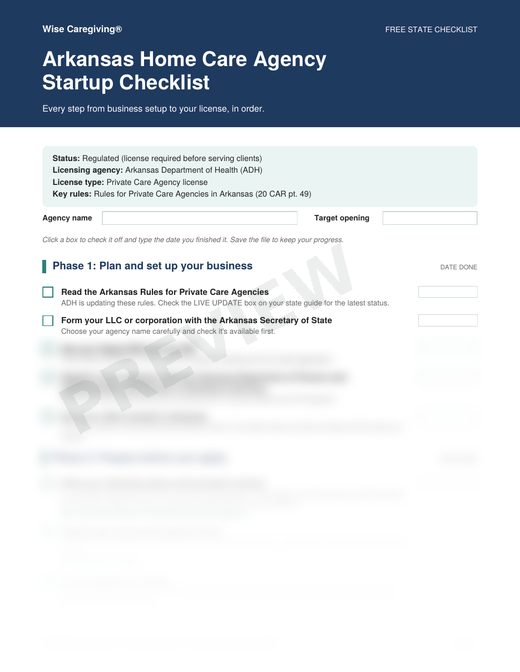 Preview of page 1 of 3
These agencies may provide skilled medical services or non-medical personal care services, depending on the type of license issued.
Non-medical home care services include assistance with daily activities that help individuals remain safely in their homes.
Typical services may include:
• companionship
• personal care assistance
• meal preparation
• light housekeeping
• errands and transportation
• medication reminders
These services do not include skilled nursing care unless the agency obtains the appropriate license classification.
Arkansas Home Care Licensing Authority
Home care agencies in Arkansas are regulated by the:
Arkansas Department of Health (ADH)
Division of Health Facility Services
Official website:
https://www.healthy.arkansas.gov
Agencies must comply with the Rules for Private Care Agencies (20 CAR pt. 49).
Private Care Agency License vs. Home Health Licenses
Most non-medical personal care agencies in Arkansas are licensed as Private Care Agencies by the Arkansas Department of Health under the Rules for Private Care Agencies (20 CAR pt. 49). Licenses run by calendar year and expire December 31. A Class B Home Health license (which needs a Permit of Approval) is for home health agencies, not private care agencies. Updates to the private care rules were proposed in July 2026.
Arkansas also issues Class A and Class B home health licenses. Those are for agencies providing skilled or medically directed home health services, and Class B home health agencies need a Permit of Approval first. A non-medical agency providing personal care, homemaker or companion services applies for a Private Care Agency license instead.
Permit of Approval (Home Health Agencies Only)
A Permit of Approval (POA) is required for home health agencies. It is not required for a Private Care Agency license.
Step 1: Choose Your Business Structure
Before applying for licensing, you must establish your legal business entity.
Common business structures include:
• Sole Proprietorship
• Limited Liability Company (LLC)
• Corporation
Many home care entrepreneurs choose an LLC because it provides liability protection and flexible taxation.
Businesses must register with the:
Arkansas Secretary of State
Step 2: Register Your Business in Arkansas
After choosing a business structure, you must register your company with the state.
This typically involves filing:
• Articles of Organization (LLC)
• Articles of Incorporation (Corporation)
You should also verify that your business name is available through the Arkansas business registry.
Step 3: Obtain a Federal Employer Identification Number (EIN)
Most home care agencies must obtain an Employer Identification Number (EIN) from the Internal Revenue Service.
An EIN is used for:
• filing federal taxes
• opening a business bank account
• hiring employees
Apply for an EIN here:
Step 4: Apply for a Private Care Agency License
Apply to the Arkansas Department of Health for a Private Care Agency license under the Rules for Private Care Agencies (20 CAR pt. 49). Licenses run by calendar year and expire December 31. Proposed updates to the rules (covering training, contractors and registry checks) had public comment through August 4, 2026; final rules are pending.
Office Requirements for Home Care Agencies in Arkansas
Arkansas home care agencies must maintain an administrative office where business operations are conducted and agency records are stored.
The office must allow for:
• secure storage of client records
• employee documentation
• administrative operations such as scheduling and billing
Some agencies begin operations from a home-based administrative office, provided local zoning rules permit home-based businesses.
However, agencies must ensure that:
• records remain accessible for state inspections
• confidential information is securely stored
A virtual office alone may not satisfy recordkeeping requirements if the agency cannot provide access to documents during inspections.
Step 5: Develop Policies and Procedures
Home care agencies must maintain written policies describing how the agency operates.
Typical policy sections include:
• admission and discharge policies
• caregiver qualifications and supervision
• infection control procedures
• abuse reporting procedures
• complaint resolution processes
These policies help demonstrate compliance with state regulations and ensure consistent care for clients.
Step 6: Hire and Train Caregivers
Agencies must recruit qualified caregivers and maintain proper employee documentation.
Typical requirements include:
• caregivers must be at least 18 years old
• criminal background checks
• reference verification
• training documentation
Providing structured training programs helps ensure safe and professional care delivery.
Step 7: Obtain Business Insurance
Insurance helps protect your agency from financial risk.
Common policies include:
• General Liability Insurance
• Workers’ Compensation Insurance
• Professional Liability Insurance
Proof of insurance may be required during the licensing process.
Preparing for the Arkansas State Survey
Before receiving final approval to operate, your agency may undergo a state inspection or survey conducted by the Arkansas Department of Health.
Surveyors evaluate whether the agency complies with licensing regulations.
During the survey, inspectors may review:
Agency Administration
• licensing documents
• organizational structure
• administrator qualifications
Client Records
• care plans
• service agreements
• visit documentation
Employee Files
• background checks
• training documentation
• employment records
Policies and Procedures
• infection control policies
• client rights documentation
• complaint procedures
Agencies should ensure that all documentation is organized and readily accessible before the inspection.
Step 8: Establish Your Office and Begin Marketing
Once licensed, agencies can begin marketing services within their community.
Common marketing strategies include:
• building relationships with healthcare providers
• networking with senior communities
• creating a professional website
• advertising locally and online
Strong referral relationships often become the primary source of new clients for home care agencies.
Resources for Starting a Home Care Agency in Arkansas
Starting a home care agency requires careful planning and compliance with state regulations.
Wise Caregiving® provides professional templates and operational resources designed to help entrepreneurs launch and manage home care agencies.
These tools include:
• policy and procedure manuals
• client intake forms
• employee hiring documentation
• caregiver training records
• administrative templates commonly used by home care agencies
OBTAIN THE START-UP FORMS AND DOCUMENTS NEEDED TO SET UP YOUR PERSONAL CARE AGENCY IN THE SHOP BELOW
Last Updated: October 2026
LIVE UPDATELatest Arkansas licensing updates
October 2026: No new changes to Arkansas’s home care licensing requirements this month.
Earlier in 2026: Arkansas has proposed updates to its Rules for Private Care Agencies (20 CAR pt. 49) covering training, contractors and registry checks. Public comment closed August 4, 2026; final rules are pending.
We check Arkansas’s official state sources at the start of every month. Last checked: October 2026.
Arkansas is a regulated state
The bundle you need: Regulated State Start-Up Bundle, with a policy and procedure manual written for Arkansas and your agency, plus the full library of 250+ templates.
Get the Regulated State Bundle for Arkansas
Only need part of it? You can buy the custom Arkansas manual on its own, the forms bundle without a manual or individual forms separately. Questions? Message us in the shop chat.