Last updated: September 2026
Starting a non-medical home care business lets you help seniors stay safely at home while building a business in a fast-growing field. This guide walks you through the whole path, from choosing your location to serving your first client, in 10 clear steps. The short version: register your business, get your EIN and insurance, find out whether your state requires a home care license, prepare your policies and forms, then hire, price and market your services.
What is a non-medical home care business?
A non-medical home care agency sends caregivers to help older adults and people with disabilities with everyday life. Caregivers do not provide skilled nursing or medical treatment. Typical services include:
- Companionship: conversation, activities, outings and social events
- Personal care: help with bathing, grooming, dressing and toileting
- Household help: light housekeeping, laundry, meal preparation
- Errands and transportation: groceries, pharmacy, banking and appointments
- Respite: giving family caregivers a break
Whether you offer personal care (hands-on help) is important: in many states, personal care is what triggers a home care license. See the full list on our non-medical caregiver services page.
Why start a home care business now?
Most older adults want to stay in their own homes as they age, and families increasingly look for trusted help to make that possible. Demand for caregivers keeps growing as the population ages, and a well-run agency can start small, with low overhead, and grow one client at a time.
How to start a non-medical home care business in 10 steps
Step 1: Choose your location and check your state’s rules
Where you operate decides your licensing requirements. Some states license non-medical home care agencies before they can serve clients; others don’t. Start by reading the startup requirements for regulated and non-regulated states, then find your state guide. Also look at local demand: private homes, retirement communities, assisted living and senior housing.
Step 2: Pick a business structure
Most owners choose a Limited Liability Company (LLC) because it protects personal assets and offers flexible tax options. Other options are a sole proprietorship, partnership or corporation. An accountant or business advisor can help you choose.
Step 3: Choose your agency name
Pick a professional name that says what you do and is easy to remember. Check that it’s available in your state’s business registry (usually on the Secretary of State website) and grab a matching website domain.
Step 4: Register your business
File your formation documents with the state, such as Articles of Organization for an LLC. Keep copies: you’ll need them for your bank, your license application and, for our larger bundles, business verification.
Step 5: Get your EIN and tax numbers
Apply for a free Employer Identification Number (EIN) from the IRS. You need it to hire employees, open a bank account and file taxes. Some states also require a state tax ID.
Step 6: Open a business bank account and get insured
Keep business money separate from personal money. Then get general liability insurance, and workers’ compensation once you have employees. Many states and clients also expect bonding.
Step 7: Prepare your policies, procedures and forms
Every agency needs a policy and procedure manual, client intake and care plan forms, service agreements, an employee handbook, hiring and training records, and scheduling and billing sheets. In regulated states, your policy manual is usually part of the license application.
Step 8: Apply for your license (regulated states)
If your state requires a license, submit your application to the state health department or licensing agency. Expect to provide business registration, background checks, your policy manual, proof of insurance and training documentation. Many states also inspect before approval. Your state guide lists the details.
Step 9: Hire and train caregivers
Write a clear job description, use a structured interview script, check references and background checks, and keep training records for every employee.
Step 10: Set your rates and find your first clients
Use our guide to home care rates to price your services, then build referrals with local healthcare professionals, senior communities and online listings. See how to market your home care business and where to advertise.
Regulated or non-regulated state: which startup bundle do you need?
Both Wise Caregiving® startup bundles give you the documents from Step 7, ready to edit in Microsoft Word, Excel and Adobe PDF. The difference is the policy and procedure manual.
|
Non-Regulated State BundleA general, all-state policy and procedure manual you edit yourself, plus 250+ client, employee and administrative templates. Instant download. |
Regulated State BundleA policy and procedure manual written for your state and your agency by Danielle, delivered in about 1–2 weeks with one revision after state review, plus the full library of 250+ templates. |
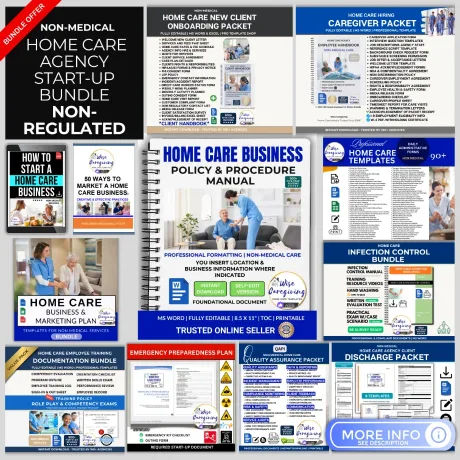
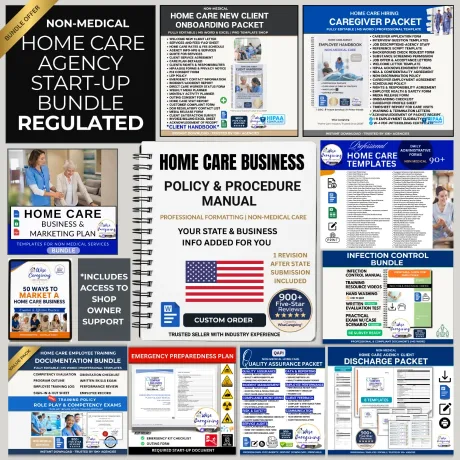
What’s inside both bundles: 250+ templates in total, including a how to start a home care business guide, editable business plan and financial forecasting sheets, 50 ways to market your agency, 85+ client and employee forms, new client packet and handbook, employee handbook and hiring packet, training records and skills evaluations, scheduling sheets, infection control and emergency preparedness materials, and quality assurance templates. Not sure which applies to you? Use our bundle chooser.
Only need part of a bundle? You can buy a custom state policy manual, the all-state policy manual template, the 85+ forms bundle or individual forms on their own. Questions? Message us in the shop chat.
Created by a home care business owner
Wise Caregiving® was created by Danielle Foley, who has owned and operated a non-medical home care business for more than 10 years and has worked with seniors in private homes, retirement residences, assisted living and care facilities. Every template comes from that real-world experience, not from copied content or AI shortcuts. Read more about Wise Caregiving®.
Frequently asked questions
How much does it cost to start a non-medical home care business?
Costs depend mostly on your state’s licensing fees and insurance. Many owners start from home with a small budget. See our guide to starting a home care business on a budget.
Do I need a license to start a home care business?
It depends on your state and on whether you provide personal care. Every agency must register as a business; many states also require a home care license. Check the startup requirements and your state guide.
Do I need medical training to own a non-medical agency?
Owners usually don’t need a medical license to run a non-medical agency, but some states require a qualified administrator or supervisor, and caregivers need the training your state specifies. Your state guide explains what applies.
Can I start without a consultant?
Yes. Many owners handle the startup steps themselves with a clear checklist and ready-made documents. Our bundles were built for exactly that, and live chat support is available if you get stuck.
Which states are best for starting a home care agency?
See our guide to the best states to start a home care agency, and why 2026–2027 is a strong time to start.
Ready to start?
Non-Regulated State Bundle Regulated State Bundle with Custom Manual